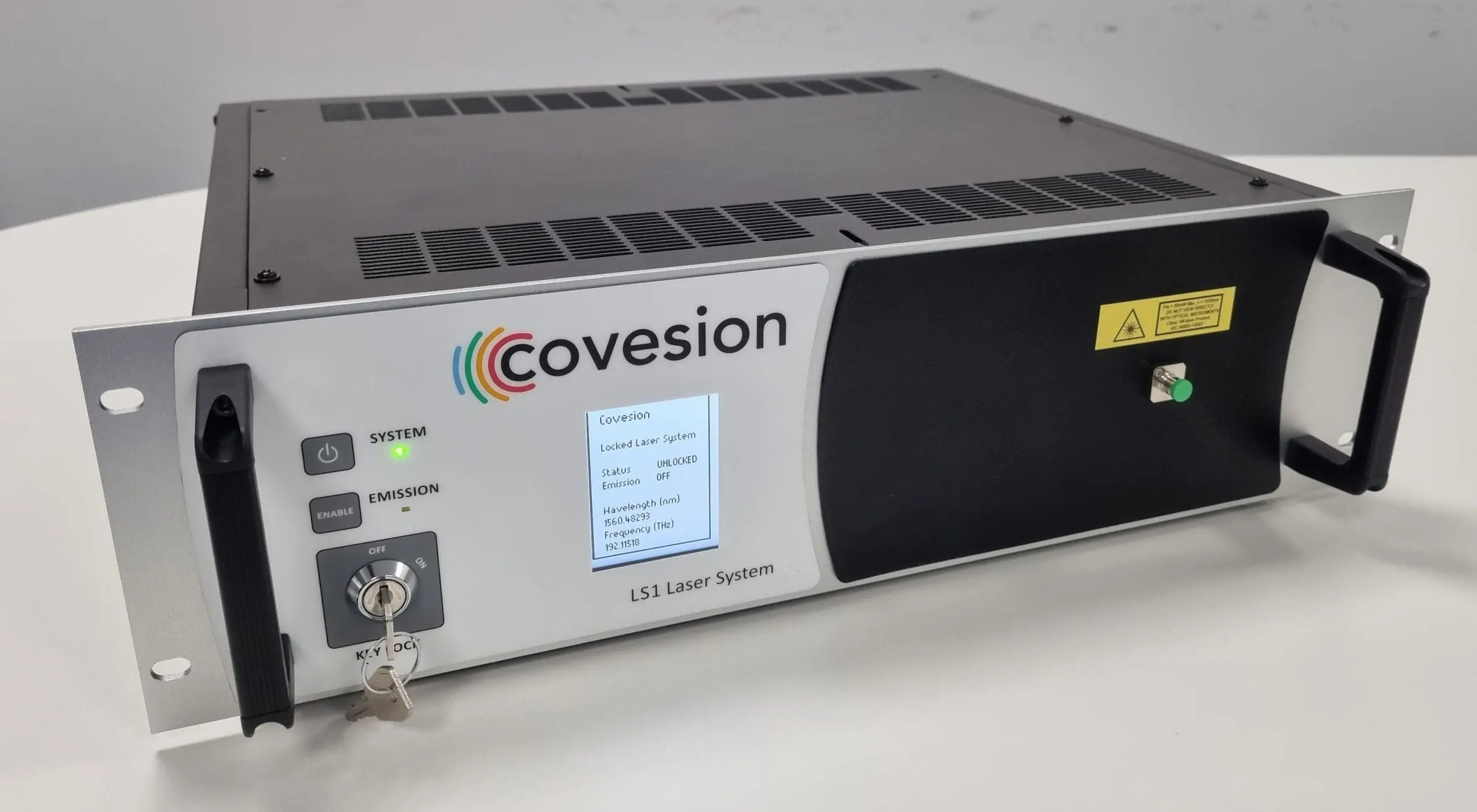
Precision Unlocked: Covesion Launches Frequency-Stabilised Laser System for Quantum Innovation
Covesion is excited to announce the launch of its Locked Laser System, a turnkey solution built on our established fibre-coupled MgO:PPLN waveguide technology. Designed to support rubidium (Rb) atom applications, including quantum computing, sensing, and timing, the system delivers a highly stable, narrow-linewidth laser output at 780 nm, frequency-locked via an integrated Rb spectroscopic cell.
The Locked Laser System automatically provides a locked, offset frequency output, enabling users to define the frequency offset relative to the absolute reference. This ensures a spectrally pure, stable output ideal for precision applications. A DC seed offset is employed to maintain lock, offering a stronger lock and improved spectral quality. Importantly, the output beam is not part of the locking process, helping to maintain its optical purity during operation.
The system is also designed with flexibility in mind, offering a customisable platform suitable for a range of setups and end uses. An optional fast modulation feature is available, supporting experiments or systems that require rapid output variation.
Locked laser system key features:
Turnkey system with locked, offset frequency output
Based on Covesion’s fibre-coupled MgO:PPLN waveguide technology
Rb spectroscopic cell provides absolute frequency reference
Output beam excluded from the locking loop
DC seed offset enhances lock strength and spectral purity
User-selectable frequency offset from reference
Optional fast output modulation
Targeted for Rb-based quantum applications
Complementing our expanding range of photonic solutions for precision R&D and OEM deployment, the Locked Laser System is available to order now and is featured in the latest version of our product catalogue.
To learn more, visit the product page or contact our team for technical specifications and ordering details.
Ferroelectric domain engineering of Lithium niobate
Jackson J. Chakkoria, Aditya Dubey, Arnan Mitchell and Andreas Boes
Abstract
Lithium niobate (LN) has remained at the forefront of academic research and industrial applications due to its rich material properties, which include second-order nonlinear optic, electro-optic, and piezoelectric properties. A further aspect of LN’s versatility stems from the ability to engineer ferroelectric domains with micro and even nano-scale precision in LN, which provides an additional degree of freedom to design acoustic and optical devices with improved performance and is only possible in a handful of other materials. In this review paper, we provide an overview of the domain engineering techniques developed for LN, their principles, and the typical domain size and pattern uniformity they provide, which is important for devices that require high-resolution domain patterns with good reproducibility. It also highlights each technique’s benefits, limitations, and adaptability for an application, along with possible improvements and future advancement prospects. Further, the review provides a brief overview of domain visualization methods, which is crucial to gain insights into domain quality/shape and explores the adaptability of the proposed domain engineering methodologies for the emerging thin-film lithium niobate on an insulator platform, which creates opportunities for developing the next generation of compact and scalable photonic integrated circuits and high frequency acoustic devices.
The scalability of quantum communication networks requires compact, fiber-integrated, easy-to-deploy, and efficient wavelength-division-multiplexed (WDM) sources for multi-user secure key distribution. Here, we demonstrate such a multi-channel source of polarization-entangled photon pairs in the low-loss telecom C-band based on type-0 spontaneous parametric downconversion in a fiber-coupled Zn-indiffused MgO-doped periodically poled lithium-niobate (MgO:PPLN) ridge waveguide in the Sagnac configuration. The source can be easily tuned to generate the |Φ+⟩ or |Φ−⟩ Bell state in 14 channel pairs of the International Telecommunication Union dense WDM (100-GHz spacing) grid around 1550-nm with a raw fidelity of ≳89%, with a maximum value of ≳94%. The raw concurrence is ≳0.8 for both Bell states in all channel pairs, and the observed S-parameter (>2.56 ± 0.04 in all 14-channel pairs) shows a strong violation of CHSH-Bell’s inequality. The source’s suitability for long-distance entanglement transmission is also demonstrated by the successful transfer of entangled photons up to 100 km while maintaining fidelity >85% and quantum bit error rate <9%. The effect of polarization mode dispersion on entanglement distribution among remote users is also studied in detail. All these performance metrics are measured using conventional room-temperature semiconductor-based single-photon avalanche detectors, and these are the best reported with these detectors. Our highly flexible source can support up to ∼40 user pairs to communicate simultaneously, and it can be easily deployed into the current metro-area fiber-optic telecom infrastructure to form a complete WDM-based quantum communication network.
Continuous-Wave 3.1 – 3.6 μm Difference-Frequency Generation of Dual Wavelength-Tunable Fiber Sources in PPMgLN-Based Rapid-Tuning Design
Junging Zhao, Fugiang Jia, Yutong Feng, Johan Nilsson
Abstract
Continuous-Wave 3.1 – 3.6 μm Difference-Frequency Generation of Dual Wavelength-Tunable Fiber Sources in PPMgLN-Based Rapid-Tuning Design Junqing Zhao, Fuqiang Jia, Yutong Feng, and Johan Nilsson Abstract—We report on a single-frequency continuous wave (CW) difference-frequency generation (DFG) source based on single-frequency wavelength-tunable polarization-maintaining ytterbium- and erbium-doped fiber master oscillator–power amplifiers (MOPAs), acting as the pump and signal source, respectively, and a 40-mm long periodically poled MgO-doped LiNbO3 (PPMgLN) crystal. Owing to the dual wavelength-tuning of the MOPAs, the generated idler light reaches a wavelength-tuning range of close to 500 nm, from ~3117.2 to ~3598.8 nm, only by tuning the launched pump and signal wavelengths from 1040 nm to 1084.6 nm and from 1545.2 nm to 1561.4 nm, respectively, without any change of temperature or grating period of the PPMgLN. Compared to temperature-based idler-wavelength-tuning, this method is potentially faster in speed. The maximum idler power exceeds 60 mW, which is the highest reported power for a wavelength-tunable single-frequency CW DFG source. A rapidly wideband-tunable DFG source with tens of milliwatts of output power in a narrow line can be a practical tool for mid-infrared molecular spectroscopy, detection, and sensing at high measurement rates.
Synchronization of Dissipative Soliton Resonance Lasers via Cascaded Cross-Phase and Cross-Absorption Modulation for Mid-infrared Mode-locked Pulse Generation
Piotr Bojęś, Piotr Jaworski, and Karol Krzempek
Abstract
Cross-phase and cross-absorption modulation effect is used to synchronize the pulse repetition frequency and duration of two dissipative soliton resonance mode-locked lasers, which were subsequently used in to generate mid-infrared pulses via difference frequency generation.
Periodically Poled Lithium Niobate (PPLN) is a non-linear optical material widely used for efficient frequency conversion, such as second harmonic generation (SHG), sum frequency generation (SFG), difference frequency generation (DFG ) and optical parametric oscillation (OPO). The key to PPLN’s functionality is the use of quasi-phase matching (QPM), achieved through periodic poling of the ferroelectric domains within the lithium niobate (LiNbO3) crystal.
Covesion’s proprietary poling process enables the fabrication of high quality, periodically poled gratings with a wide range of designs.
This guide provides an overview of PPLN crystal grating designs and their suitability for different applications.
Quasi-phase matching (QPM)
QPM compensates for phase mismatches in non-linear interactions by periodically inverting the non-linear coefficient d33 within the PPLN crystal. The phase-matching condition is given by[1]:
where:
kp, ks, ki are the wave vectors of the pump, signal, and idler waves,
⋀ is the poling period,
∆k is the phase mismatch.
Proper selection of the poling period ensures efficient energy transfer in the desired frequency conversion process. The required poling period varies with temperature, wavelength, and material dispersion, necessitating precise control of the grating fabrication.
Types of grating designs
Covesion are able to fabricate a wide variety of grating designs. These are available as off-the-shelf and custom solutions.
Single-period gratings
A single periodic structure used for narrowband phase matching, typically optimized for a specific wavelength and temperature.
Multi-period gratings
Integration of multiple, single period grating structures within the same crystal, enabling phase matching across a wide wavelength range
Chirped and aperiodic gratings
A continuously varying poling period designed for broadband phase matching and pulse compression applications. The design can be linear or aperiodic to optimize conversion across multiple wavelengths and fine control the output spectrum.
Fan-out gratings
A spatially varying poling period that allows phase matching across a range of wavelengths by translating the beam across the crystal’s width. This enables the crystal to be wavelength tuned at a fixed temperature. This is often used in OPO systems for tuneable mid-IR generation via a combination of temperature and spatial tuning.
Examples of PPLN Crystal Grating Designs
Summary
PPLN crystal grating design enables efficient frequency conversion through quasi-phase matching. By carefully selecting and optimizing the poling period, structure, and fabrication techniques, PPLN gratings can be tailored for a wide range of optical applications covering the entire lithium niobate transmission window from 390nm to 6µm. Contact us for more details of the standard and custom crystal designs that we offer.
References
J. A. Armstrong, “Interactions between light waves in a nonlinear dielectric”, Phys. Rev. 127 (6), 1918 (1962)
Quantum frequency conversion (QFC), which converts the frequencies of photons while preserving the quantum state, is an essential technology for realizing the quantum internet and quantum interconnect. In the QFC from the visible to the telecom wavelengths around 1.5 µm, it is widely known that noise photons produced by the strong pump light used for the process contaminate the frequency-converted photon. It degrades the quality of the quantum property of the output photon. Conventional experiments have employed external narrowband frequency filters to eliminate the noise photons. In this study, we present a compact QFC device integrating the cavity structure only for the converted mode. While the cavity structure enhances both the desired efficiency and the noise photon generation, we show that the cavity-enhanced QFC followed by a relatively wide bandpass filter achieves a signal-to-noise ratio (SNR) comparable to conventional systems using external narrowband filters. We experimentally demonstrate the cavity-enhanced QFC for a single photon, converting it from 780 nm to 1540 nm, and successfully observe the non-classical photon statistics after conversion.
Nonlinear Frequency Conversion of Dissipative Soliton Resonance Pulses Using the Second Harmonic Generation Effect
Piotr Bojes, Piotr Jaworski and Karol Krzempek
Abstract
We present the first demonstration of using the second harmonic generation effect to upconvert dissipative soliton resonance laser pulses. We have designed and built two independent dissipative soliton resonance lasers, emitting rectangular shaped, nanosecond pulses in the 1.06 µm and 1.56 µm wavelength regime, respectively. Periodically poled lithium niobate crystals with appropriate periods were used as the nonlinear medium. Dissipative soliton resonance pulses with central wavelengths of 532 nm and 780 nm and pulse energies of 0.15 µJ and 0.02 µJ were generated as the result of the second harmonic generation effects. Conversion efficiencies of 30% and 4% were obtained for conversion of 1.06 µm and 1.56 µm pulses, respectively.
WHITE PAPER: Periodically Poled Lithium Niobate (PPLN) used for Optical Parametric Oscillator (OPO) Applications
In this white paper, Dr RongRong Xu, Head of Scientific Sales discusses using periodically poled lithium niobate (PPLN) for optical parametric oscillator (OPO) applications.
Nonlinear crystals are one category of optical materials that exhibit specialised properties when interacting with light. In contrast to linear optical interactions between light and medium, where the magnitude of the effect that the medium has on light does not change with the light intensity, nonlinear crystals react in proportion to the intensity of the light and consequently change the light properties such as frequency, phase, and polarisation. The nonlinear response of such crystals to the incident light fundamentally originates from the χ(2) nonlinearity due to the asymmetric crystal lattice structure.
There are a variety of materials for making the nonlinear crystal, among which the most popular nonlinear crystals are Lithium Triborate (LBO), Beta Barium Borate (BBO), Potassium Titanyl Phosphate (KTP), Lithium Niobate (LiNbO3), Cesium Lithium Borate (CLBO) and Gallium Selenide (GaSe)
Periodically poled lithium niobate crystals with multiple gratings
Below is a comparison of commonly used nonlinear crystals in terms of their optical and nonlinear properties:
Table 1. Comparison of commonly used nonlinear crystals
Parametric Frequency Conversions
Frequency conversion using nonlinear crystals is a widely used method to generate new light frequency/wavelength that is not readily available.
For example, second harmonic generation (SHG) converts a single laser of its wavelength into half number; sum frequency generation (SFG) multiplies two individual lasers and generates a new laser beam with a wavelength that is shorter than the original wavelengths; difference frequency generation (DFG) combines two individual lasers but produce a new laser beam with a wavelength that is longer than the original wavelengths.
In addition, QPM allows one to select the light propagation angle inside the crystals to use the largest nonlinear coefficient of the material in the nonlinear interaction. In comparison to birefringent phase matching, quasi-phase matching (QPM) offers great advancement in eliminating the spatial walk-off and increasing nonlinear coefficient, which can effectively enhance frequency conversion efficiency and improve beam qualities of the generated new waves.
Periodically Poled Lithium Niobate
Periodically poled lithium niobate (PPLN) is a typical engineered QPM material for highly efficient nonlinear wavelength conversion processes.
As a ferroelectric crystal, lithium niobate contains unit cells with a small electric dipole moment and the orientation of the electric dipole is dependent on the positions of the lithium and niobium ions within the cell. By applying a high electric field, the crystal structure within the unit cell can be inverted and consequently, the orientation of the electric dipole can be flipped.
To fabricate PPLN, a lithium niobate wafer is lithographically patterned with a periodic electrode structure, which is then placed underneath electrodes and a high voltage is applied to the electrodes to create periodically poled regions with the desired shape. The poling period with which then crystal needs to be created depends on the phasematching condition of the interacting wavelengths for the parametric process. The phase-matched wavelengths can be tailored by designing a PPLN with different poling periods.
Multiple different poling period channels can be fabricated on a single PPLN crystal to extend the operating wavelength. Furthermore, temperature tuning of PPLN crystals offers another degree of control on the phase-matched wavelength.
Periodically poled lithium niobate crystal with single grating
Fan-out gratings in PPLN are specially designed patterns of periodic poling that allow for quasiphase matching across a range of wavelengths. These gratings are particularly useful in optical parametric oscillator (OPO) setups where wide tunability or simultaneous generation of multiple wavelengths is desired. The grating period in a fan-out structure changes gradually along the width of the crystal. Fan-out gratings enable broad tunability in OPO systems, where the signal and idler wavelengths can be adjusted by moving the pump beam along the grating under a fixed temperature.
Overall, PPLN provides great flexibility in phase-matching design for a wide range of parametric frequency conversions.
Fabrication of periodically poled lithium niobate (PPLN)
Optical Parametric Oscillator
One of the most common uses of PPLN in generating new wavelength sources is in an optical parametric oscillator (OPO). Similarly to a typical laser oscillator, OPO consists of a pump source, a gain medium and a resonator.
Instead of using rear-earth ions doped materials for laser oscillators, OPO employs nonlinear materials, PPLN as an example, to generate a parametric process and hence frequency convert the pump wavelength to different wavelengths.
The great advancement of an OPO is the ability to generate tuneable coherent radiation from a single incident laser beam.
When the incident laser beam, named pump, interacts with the nonlinear crystal, two new beams, named signal and idler, can be generated under a phase-matched condition. This can be pictured as one pump photon is split into a pair of photons respecting the energy conservation law.
The initial parametric generation builds up on quantum noise, and the signal and idler waves are amplified during each pass through the nonlinear crystal under resonance by the OPO cavity. Therefore, a certain pump threshold, depending on the OPO cavity design, has to be reached to achieve steady oscillation. There are two types of configurations to the OPO cavity, such as singly resonant OPO and doubly resonant OPO, depending on whether a single wave or both waves of the signal and idler are resonated by the OPO cavity mirrors.
Doubly resonant OPOs can have lower pump thresholds than singly resonant OPOs, however, they are subject to constraints on their cavity length for fulfilling resonant conditions for both the signal and idler waves. Hence singly resonant OPOs are generally more common than doubly resonant OPOs in practical use. In some cases, the pump beam may also be reflected by one of the cavity mirrors to form a double-pass pumping configuration for enhancing frequency conversion efficiency.
Typical schematic of an OPO
OPOs can operate in either continuous wave (CW) or pulsed regime, depending on the pump laser source, as the OPOs will generally generate output with a temporal profile similar to the pump laser1. Pumped by a CW or a long-pulsed laser (nanosecond or longer), the long length of nonlinear crystals can be employed for the OPO to enhance conversion efficiency and output power, although longer crystals would require narrower spectrum for the pump due to the limited pump spectral acceptance bandwidth.
Whereas short pulses (picosecond or shorter) pumped OPOs require a match between the cavity length and the pump repetition rate to ensure that the resonant round-trip time equals the time between pump pulses. This is known as synchronously pumped OPO. Temporal walk-off between the short pulses at different wavelengths, originating from group velocity dispersion in the nonlinear crystal, needs to be prevented when selecting the crystal length.
Generally, synchronously pumped OPOs produce pulses with the same repetition rate as the pump pulse, although higher harmonic repetitions can also be realized to fulfil the temporal synchronization. Normally it is challenging to develop a low-repetition short-pulsed OPO due to the very long cavity length requirement for synchronous pumping. There are some techniques been reported to overcome such problems, for example, a high-harmonic OPO with a short cavity length successfully operate at a repetition rate of 1MHz2.
Fiber-feedback OPO is another solution to operate the short-pulsed OPO at a low repetition rate while maintaining a compact cavity3.
Examples of Using PPLN for OPO
The appealing characteristics of high nonlinear coefficient, wide spectral transparency and the QPM ability make PPLN crystal one of the best nonlinear mediums in OPO development for a variety of applications.
The most common OPOs are pumped by 1-µm lasers and produce tuneable output wavelengths covering both the near infrared (1.2-2.0 µm) and mid-infrared (2.0-5.0 µm). In CW operation, a highly efficient OPO with 93% pump depletion is realized based on a PPLN, which converts 86% of the pump photons to the idler output and produces 3.55W mid-infrared at 3.25µm4. For high-power operation, a CW PPLN OPO is demonstrated to generate a maximum power of 7.54W at 3µm5. Compared to the CW OPO which requires a narrow-spectral pump source to enhance the conversion efficiency, pulsed OPOs generally put less requirement on the pump spectrum and tend to have lower pump thresholds. Operating in the nanosecond regime (200ns, 300kHz), highpower fibre laser-pumped PPLN OPO is reported to generate a maximum average power of up to 10.82W at 3.75µm6.
Meanwhile, PPLN OPOs have good performance in the ultrashort pulse regime. For example, a 1-MHz OPO is demonstrated based on PPLN, which provides a tunable signal (1329-1641nm) and idler (2841-4790nm) pulses (137ps) with a maximum signal pulse energy of 10µJ and a maximum idler pulse energy of 5.1µJ7. Femtosecond OPOs based on PPLN are also attractive and useful for various applications. Widely tunable output covering 1450- 4000nm is generated from a 70-fs pumped OPO that consists of a PPLN crystal. In addition, further frequency mixings, including SHG and SFG, inside the PPLN OPO produce wavelength tunability that extends to the visible region (610-970nm)8.
OPO Applications
An OPO laser is a versatile light source with a wide range of applications due to its ability to generate tunable wavelengths. Spectroscopy explores the interaction between light and matter, focusing on how materials absorb, emit, or scatter light to reveal their chemical composition, molecular structure, and physical properties. Tunable OPO lasers play a crucial role in this field, offering precise and adjustable wavelengths that enable detailed and accurate measurements across a broad spectral range. It has wide applications in medical and biological research, material study, and environmental monitoring.9,10,11,12 Like Raman spectroscopy and infrared absorption spectroscopy, OPOs are useful for analysing molecular structures and chemical composition.
In environmental monitoring and gas sensing, OPOs are useful to detect specific molecules. OPO laser can also be used for microscopy. It provides the flexibility to precisely control the excitation wavelengths and to optimise imaging conditions. Use the tunability to match the excitation peak of fluorophores, such as Two-Photon Microscopy, using NIR to excite visible-range fluorophores for deep tissue imaging. OPO wavelengths can be adjusted to enhance the signal contrast from specific tissues in SHG/ THG Microscopy. MidIR output can be used for direct IR absorption imaging or spectroscopy. In CARS Microscopy, OPOs are excellent for generating pump and Stokes beams in vibrational imaging.
The tunable wavelength allows for targeting specific molecular vibrations. OPO lasers could also be used for defence and security. Due to mid-IR output, it can be used for jamming infrared-guided missiles. It can also be used for LIDAR by adjusting laser wavelengths to minimise atmospheric absorption for high-resolution mapping and target detection.
Covesion crystal oven with temperature controller
To conclude
In conclusion, NLO crystals provide a practical solution for the generation of a wide range of wavelengths that are not readily accessible via direct laser sources. The use of highly efficient materials that can be microstructured to enable QPM, such as MgO:PPLN, provides a highly flexible product ecosystem.
As a leading supplier of PPLN-based wavelength conversion products, Covesion can offer advice on customer-specific solutions and technical support in their setup, use, and optimization. With an extensive portfolio of COTS products and custom design capabilities, Covesion is well-placed to support the widest range of wavelength conversion applications.
References
J. Zhao, Y.Chen, D. Ouyang, M. Liu, C. Li, X. Wu, X. Xiong, L. Mo, M. Wang, X. Liu, Q. Lv, and S. Ruan, “Over 3.8 W, 3.4 µm picosecond mid-infrared parametric conversion based on a simplified one-to-many scheme,” Optics Express, vol. 32, no. 5, pp. 8364-8378, 2024.
H.-Y. Chan, S.-U. Alam, D. J. Richardson, and D. P. Shepherd, “Fiber-laser-pumped, high-energy, mid-IR, picosecond optical parametric oscillator with a high-harmonic cavity,” Optics Letters, pp. 3288-3291, 2015.
Y Wu, S Liang, Q Fu, TD Bradley, F Poletti, DJ Richardson, L Xu, “High-energy, mid-IR, picosecond fiber-feedback optical parametric oscillator,” Optics Letters, vol. 47, no. 14, pp. 3600-3603, 2022.
WR Bosenberg, A Drobshoff, JI Alexander, LE Myers, RL Byer, “93% pump depletion, 3.5-W continuous-wave, singly resonant optical parametric oscillator,” Optics letters, vol. 21, no. 17, pp. 1336-1338, 1996.
JQ Zhao, BQ Yao, Y Tian, YL Ju, YZ Wang, “High power, continuous wave, singly resonant OPO based on MgO: PPLN,” Laser physics, vol. 20, pp. 1902-1906, 2010.
Y He, Y Ji, H Wan, D Yu, K Zhang, Q Pan, J Sun, Y Chen, F Chen, “High-power mid-infrared pulse MgO: PPLN optical parametric oscillator pumped by linearly polarized Yb-doped all-fiber laser,” Optics & Laser Technology, vol. 146, p. 107547, 2022.
Y Wu, Q Fu, S Liang, F Poletti, DJ Richardson, L Xu, “15-µJ picosecond hollow-core-fiber-feedback optical parametric oscillator,” Optics Express, vol. 31, no. 14, pp. 23419-23429, 2023.
C Gu, M Hu, L Zhang, J Fan, Y Song, C Wang, DT Reid, “High average power, widely tunable femtosecond laser source from red to mid-infrared based on an Yb-fiber-laser-pumped optical parametric oscillator,” Optics letters,, vol. 38, no. 11, pp. 1820-1822, 2013.
Y. Li, B. Shen, S. Li, Y. Zhao, J. Qu, L. Liu, “Review of Stimulated Raman Scattering Microscopy Techniques and Applications in the Biosciences,” Advanced Biology, p. 2000184, 2020.
D. Polli, V. Kumar, C.M.Valensise, M. Marangoni, and G. Cerullo, “Broadband Coherent Raman Scattering Microscopy,” Laser Photonics Reviews, vol. 12, p. 1800020, 2018.
H. Xiong, N. Qian, Y. Miao, Z. Zhao and W. Min , “Stimulated Raman Excited Fluorescence Spectroscopy of Visible Dyes,” The Journal of Physical Chemistry Letters, vol. 10, pp. 3563-3570, 2019.
S. Wehbi, T. Mansuryan, R.Jauberteau, A. Tonello, K.Krupa, S. Wabnitz, H.Kano, P.Leproux, S. Vergnole and V.Couderc, “Versatile supercontinuum generation by using χ(2) and χ(3) nonlinearities in PPLN crystal for direct multiplex CARS measurement,” Proc. of SPIE, vol. 11770, pp. 11770-1-6, 2021.
In this paper, we demonstrate a simplified one-to-many scheme for efficient mid-infrared (MIR) parametric conversion. Such a scheme is based on a continuous wave (CW) single longitudinal mode master oscillator power-amplifier (MOPA) fiber system as the signal source and a picosecond pulsed MOPA fiber system, exhibiting multiple longitudinal modes, as the pump source. The signal and pump beams are combined and co-coupled into a piece of 50-mm long 5% MgO-doped PPLN crystal for the parametric conversion. As high as ∼3.82 W average power at a central idler wavelength of ∼3.4 µm is achieved when the launched pump and signal powers are ∼41.73 and ∼11.45 W, respectively. Above some threshold value, the delivered idler power shows a roll-over effect against the signal power and saturation-like effect against the pump power. Consequently, the highest conversion efficiency is observed at such a threshold pump power. To the best of our knowledge, our result represents the highest average power produced from any single-pass parametric conversion source with >3 µm idler wavelength feeding with a CW signal. Moreover, our proposed scheme can simplify the design of parametric conversion system significantly and meanwhile make the system more robust in applications. This is attributed to two main aspects. Firstly, the scheme’s one-to-many feature can reduce wavelength sensitivity remarkably in the realization of quasi-phase-matching. Secondly, for moderate power requirement it does not always require a high peak power synchronized pulsed signal source; a CW one can be an alternative, thereby making the system free from complex time synchronization and the related time jitter.