
Nonlinear Crystals
Nonlinear crystals are one category of optical materials that exhibit specialised properties when interacting with light. In contrast to linear optical interactions between light and medium, where the magnitude of the effect that the medium has on light does not change with the light intensity, nonlinear crystals react in proportion to the intensity of the light and consequently change the light properties such as frequency, phase, and polarisation. The nonlinear response of such crystals to the incident light fundamentally originates from the χ(2) nonlinearity due to the asymmetric crystal
lattice structure.
There are a variety of materials for making the nonlinear crystal, among which the most popular nonlinear crystals are Lithium Triborate (LBO), Beta Barium Borate (BBO), Potassium Titanyl Phosphate (KTP), Lithium Niobate (LiNbO3), Cesium Lithium Borate (CLBO) and Gallium Selenide (GaSe)
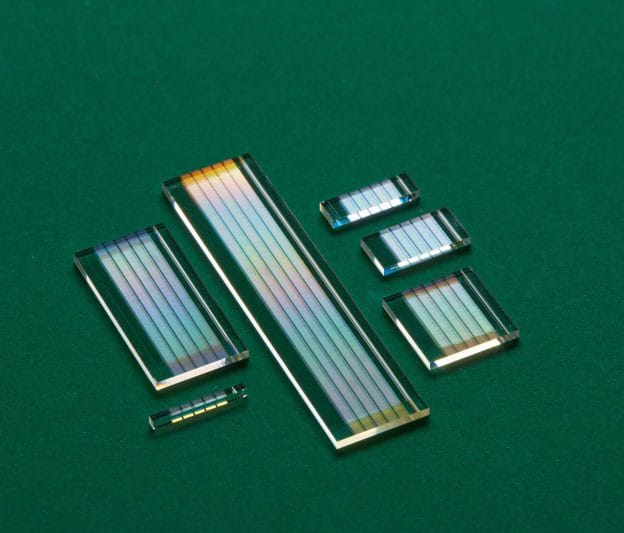
with multiple gratings
Below is a comparison of commonly used nonlinear crystals in terms of their optical and nonlinear properties:

Parametric Frequency Conversions
Frequency conversion using nonlinear crystals is a widely used method to generate new light frequency/wavelength that is not readily available.
For example, second harmonic generation (SHG) converts a single laser of its wavelength into half number; sum frequency generation (SFG) multiplies two individual lasers and generates a new laser beam with a wavelength that is shorter than the original wavelengths; difference frequency generation (DFG) combines two individual lasers but produce a new laser beam with a wavelength that is longer than the original wavelengths.
In addition, QPM allows one to select the light propagation angle inside the crystals to use the largest nonlinear coefficient of the material in the nonlinear interaction. In comparison to birefringent phase matching, quasi-phase matching (QPM) offers great advancement in eliminating the spatial walk-off and increasing nonlinear coefficient, which can effectively enhance frequency conversion efficiency and improve beam qualities of the generated new waves.

Periodically Poled Lithium Niobate
Periodically poled lithium niobate (PPLN) is a typical engineered QPM material for highly efficient nonlinear wavelength conversion processes.
As a ferroelectric crystal, lithium niobate contains unit cells with a small electric dipole moment and the orientation of the electric dipole is dependent on the positions of the lithium and niobium ions within the cell. By applying a high electric field, the crystal structure within the unit cell can be inverted and consequently, the orientation of the electric dipole can be flipped.
To fabricate PPLN, a lithium niobate wafer is lithographically patterned with a periodic electrode structure, which is then placed underneath electrodes and a high voltage is applied to the electrodes to create periodically poled regions with the desired shape. The poling period with which then crystal needs to be created depends on the phasematching condition of the interacting wavelengths for the parametric process. The phase-matched wavelengths can be tailored by designing a PPLN with different poling periods.
Multiple different poling period channels can be fabricated on a single PPLN crystal to extend the operating wavelength. Furthermore, temperature tuning of PPLN crystals offers another degree of control on the phase-matched wavelength.

Fan-out gratings in PPLN are specially designed patterns of periodic poling that allow for quasiphase matching across a range of wavelengths. These gratings are particularly useful in optical parametric oscillator (OPO) setups where wide tunability or simultaneous generation of multiple wavelengths is desired. The grating period in a fan-out structure changes gradually along the width of the crystal. Fan-out gratings enable broad tunability in OPO systems, where the signal and idler wavelengths can be adjusted by moving the pump beam along the grating under a fixed temperature.
Overall, PPLN provides great flexibility in phase-matching design for a wide range of parametric frequency conversions.

Optical Parametric Oscillator
One of the most common uses of PPLN in generating new wavelength sources is in an optical parametric oscillator (OPO). Similarly to a typical laser oscillator, OPO consists of a pump source, a gain medium and a resonator.
Instead of using rear-earth ions doped materials for laser oscillators, OPO employs nonlinear materials, PPLN as an example, to generate a parametric process and hence frequency convert the pump wavelength to different wavelengths.
The great advancement of an OPO is the ability to generate tuneable coherent radiation from a single incident laser beam.
When the incident laser beam, named pump, interacts with the nonlinear crystal, two new beams, named signal and idler, can be generated under a phase-matched condition. This can be pictured as one pump photon is split into a pair of photons respecting the energy conservation law.
The initial parametric generation builds up on quantum noise, and the signal and idler waves are amplified during each pass through the nonlinear crystal under resonance by the OPO cavity. Therefore, a certain pump threshold, depending on the OPO cavity design, has to be reached to achieve steady oscillation. There are two types of configurations to the OPO cavity, such as singly resonant OPO and doubly resonant OPO, depending on whether a single wave or both waves of the signal and idler are resonated by the OPO cavity mirrors.
Doubly resonant OPOs can have lower pump thresholds than singly resonant OPOs, however, they are subject to constraints on their cavity length for fulfilling resonant conditions for both the signal and idler waves. Hence singly resonant OPOs are generally more common than doubly resonant OPOs in practical use. In some cases, the pump beam may also be reflected by one of the cavity mirrors to form a double-pass pumping configuration for enhancing frequency conversion efficiency.

OPOs can operate in either continuous wave (CW) or pulsed regime, depending on the pump laser source, as the OPOs will generally generate output with a temporal profile similar to the pump laser1. Pumped by a CW or a long-pulsed laser (nanosecond or longer), the long length of nonlinear crystals can be employed for the OPO to enhance conversion efficiency and output power, although longer crystals would require narrower spectrum for the pump due to the limited pump spectral acceptance bandwidth.
Whereas short pulses (picosecond or shorter) pumped OPOs require a match between the cavity length and the pump repetition rate to ensure that the resonant round-trip time equals the time between pump pulses. This is known as synchronously pumped OPO. Temporal walk-off between the short pulses at different wavelengths, originating from group velocity dispersion in the nonlinear crystal, needs to be prevented when selecting the crystal length.
Generally, synchronously pumped OPOs produce pulses with the same repetition rate as the pump pulse, although higher harmonic repetitions can also be realized to fulfil the temporal synchronization. Normally it is challenging to develop a low-repetition short-pulsed OPO due to the very long cavity length requirement for synchronous pumping. There are some techniques been reported to overcome such problems, for example, a high-harmonic OPO with a short cavity length successfully operate at a repetition rate of 1MHz2.
Fiber-feedback OPO is another solution to operate the short-pulsed OPO at a low repetition rate while maintaining a compact cavity3.
Examples of Using PPLN for OPO
The appealing characteristics of high nonlinear coefficient, wide spectral transparency and the QPM ability make PPLN crystal one of the best nonlinear mediums in OPO development for a variety of applications.
The most common OPOs are pumped by 1-µm lasers and produce tuneable output wavelengths covering both the near infrared (1.2-2.0 µm) and mid-infrared (2.0-5.0 µm). In CW operation, a highly efficient OPO with 93% pump depletion is realized based on a PPLN, which converts 86% of the pump photons to the idler output and produces 3.55W mid-infrared at 3.25µm4. For high-power operation, a CW PPLN OPO is demonstrated to generate a maximum power of 7.54W at 3µm5. Compared to the CW OPO which requires a narrow-spectral pump source to enhance the conversion efficiency, pulsed OPOs generally put less requirement on the pump spectrum and tend to have lower pump thresholds. Operating in the nanosecond regime (200ns, 300kHz), highpower fibre laser-pumped PPLN OPO is reported to generate a maximum average power of up to 10.82W at 3.75µm6.
Meanwhile, PPLN OPOs have good performance in the ultrashort pulse regime. For example, a 1-MHz OPO is demonstrated based on PPLN, which provides a tunable signal (1329-1641nm) and idler (2841-4790nm) pulses (137ps) with a maximum signal pulse energy of 10µJ and a maximum idler pulse energy of 5.1µJ7. Femtosecond OPOs based
on PPLN are also attractive and useful for various applications. Widely tunable output covering 1450- 4000nm is generated from a 70-fs pumped OPO that consists of a PPLN crystal. In addition, further frequency mixings, including SHG and SFG, inside the PPLN OPO produce wavelength tunability that extends to the visible region (610-970nm)8.
OPO Applications
An OPO laser is a versatile light source with a wide range of applications due to its ability to generate tunable wavelengths. Spectroscopy explores the interaction between light and matter, focusing on how materials absorb, emit, or scatter light to reveal their chemical composition, molecular structure, and physical properties. Tunable OPO lasers play a crucial role in this field, offering precise and adjustable wavelengths that enable detailed and accurate measurements across a broad spectral range. It has wide applications in medical and biological research, material study, and environmental monitoring.9,10,11,12 Like Raman spectroscopy and infrared absorption spectroscopy, OPOs are useful for analysing molecular structures and chemical composition.
In environmental monitoring and gas sensing, OPOs are useful to detect specific molecules. OPO laser can also be used for microscopy. It provides the flexibility to precisely control the excitation wavelengths and to optimise imaging conditions. Use the tunability to match the excitation peak of fluorophores, such as Two-Photon Microscopy, using NIR to excite visible-range fluorophores for deep tissue imaging. OPO wavelengths can be adjusted to enhance the signal contrast from specific tissues in SHG/ THG Microscopy. MidIR output can be used for direct IR absorption imaging or spectroscopy. In CARS Microscopy, OPOs are excellent for generating pump and Stokes beams in vibrational imaging.
The tunable wavelength allows for targeting specific molecular vibrations. OPO lasers could also be used for defence and security. Due to mid-IR output, it can be used for jamming infrared-guided missiles. It can also be used for LIDAR by adjusting laser wavelengths to minimise atmospheric absorption for high-resolution mapping and target detection.
To conclude
In conclusion, NLO crystals provide a practical solution for the generation of a wide range of wavelengths that are not readily accessible via direct laser sources. The use of highly efficient materials that can be microstructured to enable QPM, such as MgO:PPLN, provides a highly flexible product ecosystem.
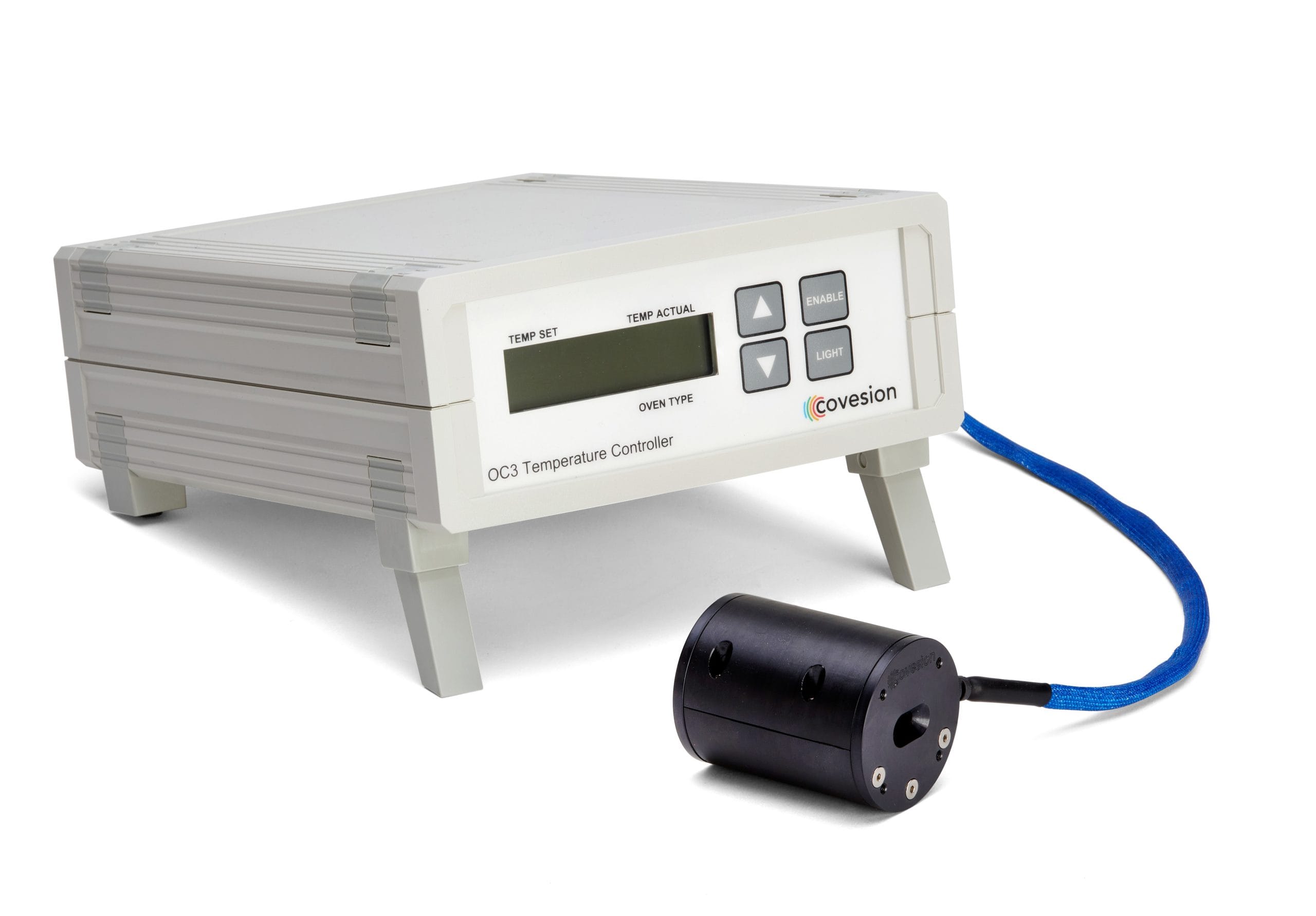
As a leading supplier of PPLN-based wavelength conversion products, Covesion can offer advice on customer-specific solutions and technical support in their setup, use, and optimization. With an extensive portfolio of COTS products and custom design capabilities, Covesion is well-placed to support the widest range of wavelength conversion applications.
References
- J. Zhao, Y.Chen, D. Ouyang, M. Liu, C. Li, X. Wu, X. Xiong, L. Mo, M. Wang, X. Liu, Q. Lv, and S. Ruan, “Over 3.8 W, 3.4 µm picosecond mid-infrared parametric conversion
based on a simplified one-to-many scheme,” Optics Express, vol. 32, no. 5, pp. 8364-8378, 2024. - H.-Y. Chan, S.-U. Alam, D. J. Richardson, and D. P. Shepherd, “Fiber-laser-pumped, high-energy, mid-IR, picosecond optical parametric oscillator with a high-harmonic
cavity,” Optics Letters, pp. 3288-3291, 2015. - Y Wu, S Liang, Q Fu, TD Bradley, F Poletti, DJ Richardson, L Xu, “High-energy, mid-IR, picosecond fiber-feedback optical parametric oscillator,” Optics Letters, vol. 47, no.
14, pp. 3600-3603, 2022. - WR Bosenberg, A Drobshoff, JI Alexander, LE Myers, RL Byer, “93% pump depletion, 3.5-W continuous-wave, singly resonant optical parametric oscillator,” Optics
letters, vol. 21, no. 17, pp. 1336-1338, 1996. - JQ Zhao, BQ Yao, Y Tian, YL Ju, YZ Wang, “High power, continuous wave, singly resonant OPO based on MgO: PPLN,” Laser physics, vol. 20, pp. 1902-1906, 2010.
- Y He, Y Ji, H Wan, D Yu, K Zhang, Q Pan, J Sun, Y Chen, F Chen, “High-power mid-infrared pulse MgO: PPLN optical parametric oscillator pumped by linearly polarized
Yb-doped all-fiber laser,” Optics & Laser Technology, vol. 146, p. 107547, 2022. - Y Wu, Q Fu, S Liang, F Poletti, DJ Richardson, L Xu, “15-µJ picosecond hollow-core-fiber-feedback optical parametric oscillator,” Optics Express, vol. 31, no. 14, pp.
23419-23429, 2023. - C Gu, M Hu, L Zhang, J Fan, Y Song, C Wang, DT Reid, “High average power, widely tunable femtosecond laser source from red to mid-infrared based on an
Yb-fiber-laser-pumped optical parametric oscillator,” Optics letters,, vol. 38, no. 11, pp. 1820-1822, 2013. - Y. Li, B. Shen, S. Li, Y. Zhao, J. Qu, L. Liu, “Review of Stimulated Raman Scattering Microscopy Techniques and Applications in the Biosciences,” Advanced Biology, p.
2000184, 2020. - D. Polli, V. Kumar, C.M.Valensise, M. Marangoni, and G. Cerullo, “Broadband Coherent Raman Scattering Microscopy,” Laser Photonics Reviews, vol. 12, p. 1800020,
2018. - H. Xiong, N. Qian, Y. Miao, Z. Zhao and W. Min , “Stimulated Raman Excited Fluorescence Spectroscopy of Visible Dyes,” The Journal of Physical Chemistry Letters, vol.
10, pp. 3563-3570, 2019. - S. Wehbi, T. Mansuryan, R.Jauberteau, A. Tonello, K.Krupa, S. Wabnitz, H.Kano, P.Leproux, S. Vergnole and V.Couderc, “Versatile supercontinuum generation by using
χ(2) and χ(3) nonlinearities in PPLN crystal for direct multiplex CARS measurement,” Proc. of SPIE, vol. 11770, pp. 11770-1-6, 2021.


